


Democracy Day Poll: Nigerians dissatisfied with democracy but optimistic about its future
Updated: Aug 10

Abuja, Nigeria. June 11th, 2026 – A new public opinion poll conducted by NOIPolls reveals significant public discontent with democratic governance in Nigeria. Nationwide, 72% of Nigerians express dissatisfaction with democracy, with 46% “not satisfied at all” and 26% “not satisfied.” Only 21% report satisfaction, with 9% “very satisfied” and 12% “satisfied.” Dissatisfaction is most pronounced in the South-East (58%) and South-South (56%) zones, while the North-East records relatively lower dissatisfaction at 33%. This regional difference suggests that citizens’ assessment of democracy is shaped by localized experiences of governance, security, and service delivery.
The reasons behind this dissatisfaction are rooted in core governance failures. For instance, among dissatisfied respondents, increased insecurity (31%), poor dividends of democracy (20%), economic hardship (19%), and poor governance (17%) are the primary drivers. For satisfied respondents, freedom of expression (26%) is the leading factor, followed by preference for democracy over military rule (13%), improved security (11%), and good governance (11%). Further evidence from the poll shows that insecurity and poor governance/leadership are viewed as the most critical obstacles to democratic progress, each cited by 25% of respondents as major challenges to democracy, alongside a poor economy (11%) and corruption (9%). Together, these findings indicate that Nigerians’ dissatisfaction stems from a perceived failure of democracy to deliver safety, economic welfare, and accountable leadership.
This perception is reflected in citizens’ evaluation of government performance across sectors. Data from the poll indicate that performance is rated poorly in areas most critical to daily life. For instance, security receives a 72% “Very Poor” rating, followed by electricity (57%), foreign policy (49%), and the economy (48%). Education performs comparatively better with the highest “Good” rating at 22%, followed by infrastructure and science & technology at 21% each. The contrast suggests that while Nigerians acknowledge modest gains in education and infrastructure, the sectors tied to personal safety and livelihoods are seen as failing, undermining confidence in democratic governance.

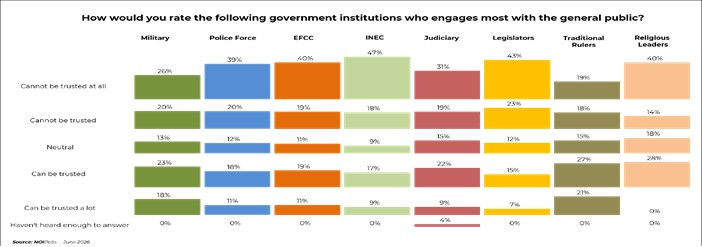
Despite widespread dissatisfaction, civic engagement remains strong, though it coexists with deep institutional distrust. The poll finds that 92% of Nigerians report having voted before, with participation consistent across gender and zones, from 88% in the South-East to 95% in the North-East. It also shows that 80% last voted in the 2023 elections. Yet the data reveal low public trust in institutions, with INEC receiving the highest “Cannot be trusted at all” rating at 47%, followed by legislators (43%) and the EFCC (40%). Respondents further assessed INEC’s efficiency and fairness poorly, with 58% rating it as “Poor” or “Very Poor.” This paradox is explained by citizen perceptions: 39% cite the belief that “my vote doesn’t count” as the reason for low turnout, with lack of trust in politicians (19%) and INEC (16%) as additional factors. This points to a democracy where citizens participate out of persistence rather than confidence.
Amid these challenges, optimism about democracy’s future persists but varies by region. The poll indicates that 71% of Nigerians remain optimistic about democracy’s future, with 45% “very optimistic” and 26% “optimistic.” Optimism is highest in the North-West (64%) and North-East (56%), and lowest in the South-East (25%) and South-South (25%). Respondents also identified clear priorities for the next year. For instance, security (74%), education (45%), healthcare (28%), and the economy (28%). These priorities align directly with the sources of dissatisfaction, indicating that citizens see democratic legitimacy as dependent on measurable improvements in safety and service delivery. These are some of the key findings from the Democracy Day Poll conducted in the week commencing June 1st, 2026.
Background
As Nigeria commemorates another Democracy Day, understanding public sentiment regarding the nation’s democratic journey is essential for informed governance and civic discourse. Democracy Day provides an annual opportunity to reflect on the progress, challenges, and aspirations that define Nigeria’s democratic experience since 1999, and to reinforce the principles of accountability, participation, and the rule of law.
Against this backdrop, NOIPolls conducted a nationwide poll to assess citizens’ satisfaction with democratic rule, their perceptions of current challenges, and their expectations for the future. The poll serves as a critical gauge of the national mood, providing data-driven insights to policymakers, civil society, and the international community.
Survey Findings
Nationwide, 46% of Nigerians are not satisfied at all with democratic rule, and an additional 26% are simply not satisfied, totaling 72% dissatisfaction. Conversely, 12% are satisfied, and 9% are very satisfied, bringing the total satisfaction to 21%, with 7% remaining neutral. Dissatisfaction is notably high in the South-East (58% not satisfied at all) and South-South (56% not satisfied at all) zones. At the same time, the North-East reports a considerably lower level, with 33% of respondents indicating they are not satisfied at all.

Among those dissatisfied, increased insecurity (31%), poor dividends of democracy (20%), economic hardship (19%), and poor governance (17%) are the primary reasons cited. For satisfied respondents, freedom of expression (26%) is the leading factor, followed by the preference for democracy over military rule (13%), improved security (11%), and good governance (11%). A notable 13% of satisfied respondents could not articulate a specific reason for their contentment.

Insecurity and poor governance/leadership are perceived as the major challenges to democracy in Nigeria, both cited by 25% of respondents. Other significant challenges include a poor economy (11%) and corruption (9%). Weak government institutions (6%), ethnicity (3%), electoral processes (3%), self-interest/greed (3%), and lack of respect for the rule of law (3%) also contribute to the perceived obstacles to democratic progress.

Government performance is largely rated poorly across key sectors. Security received the highest "Very Poor" rating at 72%, followed by Electricity (57%), Foreign Policy (49%), and Economy (48%). Conversely, Education received the highest "Good" rating at 22%, followed by Infrastructure and Science & Technology, both at 21%.

Public trust in government institutions is generally low, with the Independent National Electoral Commission (INEC) receiving the highest "Cannot be trusted at all" rating at 47%. The Legislators (43%), Economic and Financial Crimes Commission (EFCC) (40%), and Religious Leaders (40%) also face significant distrust. Traditional Rulers and the Military garnered the highest "Can be trusted" ratings at 27% and 23%, respectively.
A vast majority of Nigerians (92%) reported that they voted before, indicating a high level of civic engagement. This high participation rate is consistent across genders (92% for both males and females) and geopolitical zones, ranging from 88% in the South-East to 95% in the North-East. Notably, 100% of respondents aged 61 and above reported that they voted, compared with 81% in the 18-35 age group.

Nationwide, 80% of respondents indicated that they last voted in the 2023 elections. This trend is relatively consistent across demographics, with 81% of males and 79% of females voting in 2023. Regionally, the South-East had the highest proportion of recent voters at 87%, while the North-Central had the lowest at 77%.

The primary reason cited for low voter turnout is the belief that "My vote doesn't count," accounting for 39% of responses. Lack of trust in politicians (19%) and in INEC (16%) are also significant contributing factors. Insecurity (7%) and fear of violence eruption (6%) further deter citizens from participating in the electoral process.

Nationwide, 38% of respondents rated INEC's performance as "Very Poor," and 20% rated it as "Poor." Conversely, 17% rated it as "Good," and 9% as "Very Good." The South-East zone recorded the highest "Very Poor" rating at 69%, while the North-West had the highest "Good" rating at 20%.

Despite current challenges, a significant portion of Nigerians remain optimistic about the future of democracy, with 45% feeling "Very optimistic" and 26% feeling "Optimistic." However, 16% are "Not optimistic at all," and 9% are "Not optimistic." Optimism is highest in the North-West (64% very optimistic) and North-East (56% very optimistic), and lowest in the South-East (25% very optimistic) and South-South (25% very optimistic).

Security is overwhelmingly the top priority for Nigerians, with 74% expecting the government to focus its attention on this area in the next year. Education (45%), Healthcare (28%), and the Economy (28%) are also major areas of concern. Other priorities include Electricity (24%), Infrastructural development (23%), Agriculture (12%), and Job Creation (12%).

Conclusion
The poll portrays a democracy where citizens remain committed to participation but are increasingly disillusioned by unmet expectations. The 72% dissatisfaction rate, coupled with 47% distrust in INEC and the perception that votes do not count, signals a legitimacy deficit that threatens democratic consolidation. Nigerians continue to vote and prefer democracy over alternatives, yet this engagement is sustained by hope rather than satisfaction. Closing the gap between citizens’ democratic expectations and their lived experience will require urgent, targeted action in security and economic management.
Rebuilding institutional trust is central to this effort. With INEC, legislators, and anti-corruption agencies all facing significant distrust, reforms that enhance transparency, accountability, and performance are critical. Electoral credibility must be restored so that high participation translates into confidence in outcomes. Without this, the perception of electoral irrelevance will continue to erode democratic legitimacy, regardless of turnout figures.
The regional variations in dissatisfaction and optimism further underscore the need for differentiated governance responses. Southern zones express deeper frustration while northern zones retain greater optimism, likely reflecting differing experiences of insecurity and economic stress. National reforms must therefore be complemented by context-specific interventions that address the distinct challenges facing each geopolitical zone.
The 71% optimism about democracy’s future represents a crucial opportunity. Nigerians have not rejected democracy; they are calling for it to work. By prioritising security, education, healthcare, and economic recovery, and by demonstrating accountable governance, leaders can convert citizens’ persistence into stronger trust in democratic institutions. Finally, the path to consolidation lies in delivering tangible results that restore public confidence and validate citizens’ commitment to democratic participation.
Survey Methods
The opinion poll was conducted in the week commencing June 1st, 2026. It involved computer-assisted telephone interviews (CATI) of a proportionate nationwide sample of 1,000 randomly selected phone-owning Nigerians aged 18 years and above, representing the six geo-political regions and 36 states and the FCT of the country. Interviews were conducted in 4 Nigerian languages: Igbo, Hausa, Yoruba, Pidgin English, and English. This survey result is statistically precise, with a 95% confidence level and a margin of error of ±4.65%. However, because data were collected exclusively through telephone interviews, the findings may not fully represent Nigerians who do not own or have access to mobile phones.
NOIPolls Limited, No. 1 for country-specific polling services in West Africa. We conduct periodic opinion polls and studies on various socio-economic and political issues in Nigeria. More information is available at www.noi-polls.com.
Disclaimer
This press release has been issued by NOIPolls Limited to share information related to the topics covered in the document. We encourage the public to use and distribute our poll results, provided that NOIPolls is credited as the source whenever our poll data are referenced, cited, or published.
NOIPolls confirms that the opinions expressed in this document accurately reflect the views of the surveyed respondents. The background information provided is sourced from reliable sources; however, we do not guarantee its absolute accuracy or completeness. While thorough due diligence has been exercised in preparing this document, NOIPolls disclaims any responsibility or liability for errors, factual inaccuracies, or opinions contained herein. Any ratings, forecasts, estimates, opinions, or views included are judgments made as of the date of this document. If the date of this document is outdated, the views and content may no longer align with NOIPolls' prevailing findings or insights.
Press Contact
Email: editor@noi-polls.com
Number: +234 (0) 813 547 4512
+234 (0) 813 749 6113


